Saturday, October 17, 2009
Two Salt Lake Tribune Articles on The Lost Symbol
In one article, “Psst! Let’s Talk About Masons,” Ms. Stack writes about Freemasonry as it is depicted in The Lost Symbol, and describes aspects of her visit to the Salt Lake City Masonic Temple. She quotes John Liley (Grand Senior Warden of the Grand Lodge of Utah), Dan Burstein (editor of Secrets of The Lost Symbol), and myself.
In another article, “Mormons Off the Hook in Brown’s Book,” Ms. Stack notes that a major theme of The Lost Symbol, apotheosis, or the potential for human beings to become gods, is an echo of the Latter-day Saint (‘Mormon’) doctrine of exaltation. (I consider this matter in some detail in an earlier post on this blog.) I am quoted in the article.
Shameless Plugs
Basic questions about Freemasonry can be addressed to the author, either through a comment here, or through the “Freemasonry 101” blog.
I discuss the basics of Freemasonry in my book, Freemasonry: An Introduction, which will shortly be available again through Amazon; interested readers may ask to be notified of this availability through leaving me an e-mail at freemasonrybook@yahoo.com . I shall have a great deal to say about Freemasonry in The Lost Symbol in my forthcoming book, Discovering The Lost Symbol.
(Copyright 2009 Mark E. Koltko-Rivera. All Rights Reserved.)
Friday, October 9, 2009
Dan Brown Explains Why He Wrote About the Freemasons
We interrupt our series regarding Maureen Dowd’s review of The Lost Symbol to report some late-breaking news.
The publication of Dan Brown’s novel, The Lost Symbol, provoked a wide range of reactions, judging from the comments left on the Dan Brown Facebook fan page. Many people who left comments were overjoyed, and really loved the book.
On the other hand, a significant fraction of commenters—I’ll call them ‘the star theorists’—were less than pleased. Several individuals had predicted for months that The Lost Symbol would address one or another theory regarding such topics as the line-up of Washington DC streets with certain stars, supposed charts with kabbalistic or other mystical significance encoded in the street layout of DC, the decoding of ancient mystical manuscripts associated with King Solomon, even the type of theories about ancient astronauts long linked to the name of Erich von Daniken.
But that’s not what they got.
Instead, readers of The Lost Symbol got an adventure story that was deeply steeped in the symbolism and values of Freemasonry. This bothered the star theorists no end, even though Brown had said for years that his book would involve Freemasonry.
And so the grumbling began. Some of these people said that the Masons must have ‘gotten’ to Brown somehow, to keep him from revealing the important star map secrets that are supposedly held by the Masons. Some used accusatory tones to claim that Dan Brown himself was a Mason, as though that were some kind of crime.
Well, now the mystery of Dan Brown’s choice is solved. As reported in a post on Christopher Hodapp’s excellent blog, “Freemasons for Dummies,” Dan Brown sent a letter that was read out at a gathering held in connection with the biennial session of the Supreme Council of the Ancient and Accepted Scottish Rite of Freemasonry in the Southern Jurisdiction, held earlier this week in Washington, DC. (Some of the meetings were held in the very Temple Room at the House of the Temple that plays such an important part in the beginning and at the dramatic climax of The Lost Symbol.) As I understand it, the background of the letter is that Dan Brown had been invited to address the biennial session in person, but with Dan Brown having a heavy travel schedule, a personal appearance was impossible; he sent the letter instead.
In his letter of October 6, 2009 (photo above), Dan Brown said the following, in part:
In the past few weeks, as you might imagine, I have been repeatedly asked what attracted me to the Masons so strongly as to make it a central point of my new book. My reply is always the same: “In a world where men do battle over whose definition of God is most accurate, I cannot adequately express the deep respect and admiration I feel toward an organization in which men of differing faiths are able to ‘break bread together’ in a bond of brotherhood, friendship, and camaraderie.”
Please accept my humble thanks for the noble example you set for humankind. It is my sincere hope that the Masonic community recognizes The Lost Symbol for what it truly is … an earnest attempt to reverentially explore the history and beauty of Masonic Philosophy.
This is the reason why Dan Brown made Freemasonry central to The Lost Symbol. He respects the fact that Freemasonry encourages tolerance of religious differences, that Masonry fosters fellowship and even friendship across the lines drawn by different religious affiliations. He expresses thanks for the “noble example” that he says Masonry sets “for humankind.” In a sense, by depicting this example, he is trying to improve the world.
So that’s the story, folks. Dan Brown is not engaged in some kind of rule-the-world conspiracy. I see no evidence that he deliberately suppressed evidence that would have supported or propagated the ideas of the star theorists. He had something more important in mind:
Encouraging peace in this world.
Thank you, Mr. Brown.
Shameless Plugs
Basic questions about Freemasonry can be addressed to the author, either through a comment here, or through the “Freemasonry 101” blog.
I discuss the basics of Freemasonry in my book, Freemasonry: An Introduction, which will shortly be available again through Amazon; interested readers may ask to be notified of this availability through sending me an e-mail at freemasonrybook@yahoo.com .
I shall have a great deal to say about Freemasonry as it is depicted by The Lost Symbol in two places:
• one of my two chapters in the forthcoming book edited by Dan Burstein and Arne de Keijzer, Secrets of The Lost Symbol, which you can read about here;
• my own forthcoming book, Discovering The Lost Symbol: Magic, Masonry, Noetic Science, and the Idea that We Can Become Gods. (Publishers’ and agents’ inquiries are welcome!)
[The image of Dan Brown’s letter was obtained through a post, “Dan Brown and Why Freemasonry,” dated October 8, 2009, on the "Freemasons For Dummies" blog, which is authored by Christopher Hodapp.]
(Copyright 2009 Mark E. Koltko-Rivera. All Rights Reserved.)
Thursday, October 8, 2009
How Accurate Is the Contemporary Catholic Perception of Freemasonry?:
One of a Series on Maureen Dowd’s Review of The Lost Symbol and the Truth About Freemasonry
Ms. Dowd’s review contains much inaccurate or misleading information about Freemasonry. This blog post is one of a series in which I address the inaccuracies about Freemasonry that occur in Ms. Dowd’s review. Links to the rest of the posts in this series may be found here.
What Ms. Dowd Had to Say
In my immediately preceding post on this blog, I considered a statement that Ms. Dowd made regarding Freemasonry and the Roman Catholic Church:
My dad always said in his day that the Masons were not welcoming to Catholics. The Catholic Church once considered the Masons so anti-Catholic, Catholics who joined were threatened with excommunication.
In that earlier post, I addressed the matter of Freemasonry’s attitude towards Catholics. (As I explained there, Freemasonry is entirely welcoming to Catholics, and is not anti-Catholic at all.) In this post, I put the shoe on the other foot, and take up the matter of Catholicism’s attitude towards Freemasonry.
The Official Catholic Attitude Towards Freemasonry
The official attitude of the Roman Catholic Church has changed over time. Freemasonry has been addressed by the Vatican in a number of papal pronouncements over the last three centuries. The current official Catholic attitude towards Freemasonry is quite negative (as explained recently in a presentation made at a Masonic lodge by the Rev. Mr. John J. McManus, JD, JCL. There are two aspects of this attitude that are especially noteworthy for my purposes here today:
- The current official Catholic attitude towards Freemasonry is based on a wildly inaccurate image of Freemasonry.
- The classic papal statement on Freemasonry, Humanum Genus (1884), is based on a highly negative attitude towards values that are now commonly accepted, such as democracy and freedom of religion.
The Inaccurate Contemporary View of Freemasonry Within Catholicism
Several Catholic writers who have addressed the Catholic position on Freemasonry make reference to an official statement made in about 1980 by the German [Roman Catholic] Bishops’ Conference. In turn, this statement is summarized in an article by Monsignor Ronny E. Jenkins, “The Evolution of the Church’s Prohibition Against Catholic Membership in Freemasonry” (The Jurist, vol. 56, pp. 735-755), which itself is summarized in the McManus presentation which I have mentioned above.
I was stunned by the degree to which the image of Freemasonry portrayed by the German Bishops varied from Freemasonry as I had studied for many years, and as I have known it from the inside for some time. Consequently, I began a series regarding the Roman Catholic Church and Freemasonry on another blog that I author, “Freemasonry: Reality, Myth, and Legend”; the first part of that series is here. Although incomplete, the seven parts of the series currently on the blog are very revealing concerning the inaccuracy of the German Bishops’ (and many other Catholic leaders’) perceptions of Freemasonry. To be specific:
- The German Bishops stated that Masonry promotes a relativistic approach to reality where one should avoid commitment “to any one set of revealed truths.” As I explain in Part 2 of my series, this is a serious distortion of Freemasonry. The Masonic practice is to give respect to a variety of religious positions, but Freemasonry does not teach that one should avoid committment to one!
- The German Bishops stated that “the Masons deny the possibility of an objective truth, placing every truth instead in a relative context.” As I explain in Part 3 of my series, this is simply false from beginning to end. In fact, the Masons teach a number of objective truths, although part of the genius of Freemasonry is that it does this while still maintaining respect for different religious positions. Somehow, it seems, the German Bishops made such respect into something bad.
- The German Bishops stated that “the Masonic teaching holds a relative notion of religion as all concurrently seeking the truth of the absolute”; they seem to imply that Masons teach that all religions hold equal value. As I explain in Part 4 of my series, no branch of Freemasonry of which I have any knowledge teaches anything like this.
- The German Bishops stated that “the Masons hold a deistic notion of God”—which includes the notion that God does not intervene in the human world—a notion which “precludes the possibility of God’s self-revelation to humankind,” thus undercutting any idea of biblically based religion. As I explain in Part 5 of my series, Freemasonry does not teach Deism. If anything, Freemasonry seems to have a prominent Theistic slant (tending towards the notion of the Divine Being as revealing important things to humankind). Although there were Deists (such as George Washington and Benjamin Franklin) who were prominent Freemasons in the days of the American War of Independence, that has no relevance: Freemasonry welcomes Deists and Theists alike.
- The German Bishops stated that “the Masons promote a principle of toleration regarding ideas,” and that “such a principle … threatens the Catholic position of objective truth … [and] also threatens the respect due the Church’s teaching office.” As I explain in Part 6 of my series, yes, Masons actually do teach toleration of different ideas—but, for that matter, the Catechism of the Catholic Church does the same. (In essence, the Bishops exhibited an attitude that is outmoded even within their own church.)
- The German Bishops stated that “the rituals of [Freemasonry] have a clear sacramental character about them,” which of course would intrude on the mission of the Catholic Church as having, in the Catholic view, exclusive authority over the sacraments of grace. As I explain in Part 7 of my series, this is completely untrue, based on what the Catholic Church teaches about the sacraments, and what Freemasonry teaches about its own rituals.
- The German Bishops stated that Freemasonry claims to lead to the perfection of humankind, a position that would thus usurp the role of Christ in human life. However, the truth of the matter is that Freemasonry makes no such claim, and offers no program for the salvation of humankind.
- The German Bishops stated that “the Masonic Order makes a total claim on the life of the members.” This is nonsense; the existence of many clergy of Christian and other faiths who are Freemasons shows that the German Bishops are inaccurate.
- The German Bishops state that Masonic lodges “seek merely to adapt Christianity to the overall Masonic world-view.” This is simply inaccurate; Freemasonry teaches men to follow the precepts of their own religions, rather than adapting those religions to Freemasonry.
- The German Bishops state that Masonic lodges “are not compatible with Catholic teaching.” However, the Bishops demonstrate a fundamental misunderstanding of Masonic teaching and practice, and so entirely fail to make their case.
I have not yet completed the series on the Roman Catholic Church and Freemasonry. (After I posted Part #7 in the series, on June 6, 2009, I had to focus on moving my household to a different residence, after which I became caught up in the matter of interpreting Doubleday’s Dan Brown clues.) However, you can see where I am going with this. The current Catholic position on Freemasonry is based on an utterly inaccurate image of Freemasonry.
However, that is not the entire story.
There is, in addition to the contemporary Catholic position articulated by the German Bishops, a more classic Catholic position on Freemasonry, articulated in the papal pronouncement known as Humanum Genus (1884). That pronouncement criticizes Freemasonry on entirely different grounds from those used by the German Bishops, and it is to that pronouncement that I shall turn in my next post.
Conclusion
At least over the last 30 years or so, the Catholic position on Freemasonry has not been so much about a supposed anti-Catholic bias on the part of Masonry (as Ms. Dowd states), but has rather been about Freemasonry as a supposedly relativistic, deistic, alternative religion—none of which is true about Freemasonry at all. With all due respect to Catholicism and Catholics, the facts as I have described them above demonstrate that the contemporary Catholic position on Freemasonry is based on a perception of Masonry that is fundamentally and deeply flawed and inaccurate.
Basic questions about Freemasonry can be addressed to the author either as a comment on a post here, or through the "Freemasonry 101" blog.
Shameless Plugs
I discuss the basics of Freemasonry in my book, Freemasonry: An Introduction, which will shortly be available again through Amazon; interested readers may ask to be notified of this availability through sending me an e-mail at freemasonrybook@yahoo.com .
I shall have a great deal to say about Freemasonry as it is depicted by The Lost Symbol in two places:
- one of my two chapters in the forthcoming book edited by Dan Burstein and Arne de Keijzer, Secrets of The Lost Symbol, which you can read about here;
- my own forthcoming book, Discovering The Lost Symbol: Magic, Masonry, Noetic Science, and the Idea that We Can Become Gods. (Publishers’ and agents’ inquiries are welcome!)
[The photo of St. Peter’s Basilica in the early morning was taken on May 21, 2004 by Andreas Tille. It was obtained from Wikimedia Commons and is used here under the terms of the GNU Free Documentation License.]
(Copyright 2009 Mark E. Koltko-Rivera. All Rights Reserved.)
Are Freemasons Anti-Catholic?
One of a Series on Maureen Dowd’s Review of The Lost Symbol and the Truth About Freemasonry
On Sunday, October 11, 2009, The New York Times Book Review will publish a review by Maureen Dowd of Dan Brown’s latest novel, The Lost Symbol. That review is available on-line here. (The weekday edition of the Times previously published a review of The Lost Symbol by Janet Maslin; that review, which appeared on Monday, September 14, is available here.)
Ms. Dowd’s review contains much inaccurate or misleading information about Freemasonry. This blog post is one of a series in which I address the inaccuracies about Freemasonry that occur in Ms. Dowd’s review. Links to the rest of the posts in the series may be found here.
What Ms. Dowd Has to Say
At one point in her review, Ms. Dowd states the following:
My dad always said in his day that the Masons were not welcoming to Catholics. The Catholic Church once considered the Masons so anti-Catholic, Catholics who joined were threatened with excommunication.
Is this true? Are Masons unwelcoming to Catholics? Are Masons anti-Catholic, in any way?
Masons Are Entirely Welcoming to Catholics
I would have a very hard time finding any evidence in my own experience for the proposition that Masons were somehow ‘unwelcoming’ to Catholics. This is because the Master of my home Lodge when I became a Master Mason—the senior executive officer, as it were, of my home Lodge—is himself a Roman Catholic. The Master in my home Lodge changes every year at the annual elections (often the case in Masonic lodges; some lodges do give two-year terms to their Masters). At least one of the Masters that my home Lodge has had in subsequent years is a Roman Catholic, as well.
Freemasonry forbids Masons to consider someone’s religious affiliation when deciding whether to admit that person to the Fraternity. In fact, in most Masonic jurisdictions (certainly every one with which I am familiar), it is actually forbidden for Masons even to ask about the religious affiliation of a candidate. Yes, it is a strict and absolute requirement that a successful candidate for Freemasonry must believe in a Supreme Being. (In many jurisdictions, the precise requirement is a belief in the existence of a Supreme Being, and a belief in the immortality of the human soul.) However, candidates are free to believe whatever they wish about that Supreme Being, without jeopardizing their candidacy for Freemasonry. Candidates are also free to hold any religious affiliation that they wish, or none at all—Freemasonry simply considers such things a matter of individual conscience.
Indeed, Freemasonry forbids any discussion of sectarian religion or partisan politics in the Lodge. (I am speaking of North American lodges; some Masonic organizations in other parts of the world have different practices.)
In sum: Freemasonry is entirely welcoming to Catholics, whether they seek to learn more about Freemasonry or not.
Masons Are Not Anti-Catholic in Any Way
What does it mean to be ‘anti-Catholic’? Let’s consider some possibilities.
- Would it be anti-Catholic to teach that Catholic doctrine is incorrect? That seems a bit harsh as a judgment, given that different people will have different beliefs, but it really does not matter: Freemasonry does not do this. Any discussion, pro or con, regarding sectarian religious doctrine is forbidden in the Lodge. Freemasonry takes no position on the truth or falsehood of specific religious doctrines, beyond a basic belief in the existence of a Supreme Being and a belief in the immortality of the human soul. (Of course, individual Freemasons are welcome to their own opinions—something that is the very essence of freedom of conscience—although they are to keep those opinions to themselves, in the Lodge.)
- Would it be anti-Catholic to try to restrict the freedom of Catholics to practice their faith? Would it be anti-Catholic to discriminate against Catholics in terms of civil rights? Certainly either of these practices would be anti-Catholic—but Freemasonry does not do either of these things. In an indirect way, 18th century American Freemasons—through their support of the Bill of Rights—showed a strong support for freedom of religion in the United States. That’s just the Masonic way.
- Would it be anti-Catholic to discriminate against Catholics who wish to become Masons? Sure it would be—but Freemasonry does not do this. As I mentioned in the previous section of this post, Freemasons are actually forbidden to consider a candidate’s religious affiliation in making decisions about admitting someone to the Fraternity.
- Would it be anti-Catholic to teach religious doctrine that is un-Catholic—that is, simply different than what Catholicism teaches? That also seems a bit harsh as a judgment, given that freedom of religion should not be considered a threat to Catholicism, but it really does not matter: Freemasonry does not do this, either. Freemasonry teaches no specific religious doctrines in the Lodge. Contrary to an opinion that one sometimes comes upon, Freemasonry does not teach Deism, which is a non-Catholic form of religion. This is a point I explain comprehensively in a post on another blog, which you may read here.
It is true that Freemasonry, by and large, has shown a great deal of support for public education. In both Europe and the United States, one can come up with several examples of either Masonic Lodges or prominent individual Freemasons founding or supporting institutions of public education. However, support for public education is a long way off from anti-Catholicism, by any rational measure.
In sum: Freemasonry is not anti-Catholic. Rather, Freemasonry is entirely neutral with regards to Catholicism. (Of course, if a person thinks that religious neutrality or freedom of conscience are somehow ‘anti-Catholic’—well, then, we all have a more serious problem to deal with than the religious stance of Freemasonry.)
Conclusion
Ms. Dowd is simply wrong, plain and simple, about the stance of Freemasonry towards Catholics and Catholicism. Although I mean no disrespect to Ms. Dowd’s father, it seems that he was poorly informed about Freemasonry to start with. It is unfortunate that Ms. Dowd—a Pulitzer Prize-winning journalist who, frankly, ought to know better—simply seems to have accepted her father’s statements at face value, without checking into the facts of the matter.
Of course, this all raises the question of why Ms. Dowd’s father would have had these misconceptions about Freemasonry to start with. I shall deal with that in my next post, in which I will discuss the roots of the inaccurate perceptions that some people have had over the years regarding Freemasonry, specifically in relation to Roman Catholicism.
Basic questions about Freemasonry can be addressed to the author through the "Freemasonry 101" blog.
Shameless Plugs
I discuss the basics of Freemasonry in my book, Freemasonry: An Introduction, which will shortly be available again through Amazon; interested readers may ask to be notified of this availability through sending me an e-mail at freemasonrybook@yahoo.com .
I shall have a great deal to say about Freemasonry as it is depicted by The Lost Symbol in two places:
- one of my two chapters in the forthcoming book edited by Dan Burstein and Arne de Keijzer, Secrets of The Lost Symbol, which you can read about here;
- my own forthcoming book, Discovering The Lost Symbol: Magic, Masonry, Noetic Science, and the Idea that We Can Become Gods. (Publishers’ and agents’ inquiries are welcome!)
[The photo of Whitby Abbey, at Whitby, North Yorkshire, England, was taken on January 28, 2008, by Stephen McCulloch. It was obtained from Wikimedia Commons, and is used here under the terms of the Creative Commons Attribution-ShareAlike 2.0 license.]
(Copyright 2009 Mark E. Koltko-Rivera. All Rights Reserved.)
Monday, October 5, 2009
The Oaths of Freemasonry:
One of a Series on Maureen Dowd's Review of The Lost Symbol and the Truth About Freemasonry
Ms. Dowd’s review contains much inaccurate or misleading information about Freemasonry. This blog post is the first of a series in which I address the inaccuracies about Freemasonry that occur in Ms. Dowd’s review. The rest of the posts in the series may be found here.
Freemasons Do Not Murder Those Who Expose Their Rituals
Ms. Dowd writes of Dan Brown, “During the five years he researched this book, did Brown begin to believe those sensational stories about how, if you expose the secrets of the Masons, they will slit your throat?”
If Masons actually murdered those who exposed their rituals or other secrets, Freemasons would do little else but murder people, and the body count would have reached into the thousands quite some time ago. The ritual secrets of Freemasonry have been exposed many times over the last three centuries. We Masons may think poorly of those who expose our rituals and secrets—yes, we will de-friend them from our Facebook accounts—but we do not murder them or do them other harm.
The Oaths of Freemasonry
Stories like the kind that Ms. Down mentions have their root in an aspect of the oaths involved in becoming a Freemason. As part of the process of initiation, a candidate takes several solemn oaths. For the most part, these oaths involve commitments to moral behavior. In addition, candidates swear not to reveal Masonic secrets, such as signs of recognition, and other ritual details. The candidate swears that he “binds” himself to various bloodcurdling penalties if he breaks these obligations.
Over the years, a lot of people have been put out by the fact that Freemasons bind themselves to these bloodcurdling penalties, However, very few of the people who have commented on these oaths over the centuries have pointed out certain basic truths:
- Masons are never put under oath or asked to carry out these penalties on anyone. Indeed, because Masons are committed to observing the civil law, it easily could be argued that Masons themselves are actually forbidden by Masonic ethics to inflict these penalties on anyone, Mason or not.
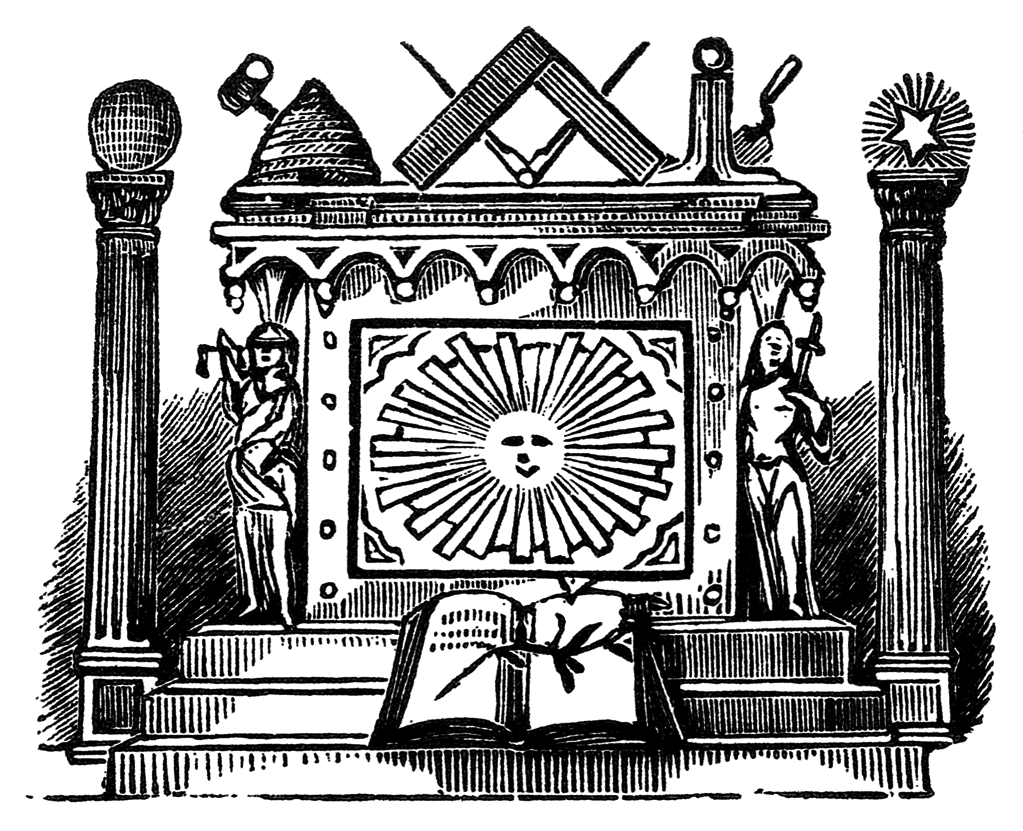
- Candidates for Freemasonry take their oaths and pronounce their obligations at sacred altars (depicted above) and in the presence of Almighty God, each man using a Volume of the Sacred Law that is sacred to him. (Some men use the Jewish Bible, some a version of the Christian Bible, some the Muslim Quran, and so on.) The obvious conclusion to draw is that the penalties to which Masons bind themselves are penalties that they expect Almighty God shall inflict on them for breaking their word.
In all of history, there is only one instance in which it could credibly be the case that someone who exposed the secrets of Masonry might have been murdered by Masons. This was the famous Morgan incident of 1826, where William Morgan—a non-Mason who pretended to be a Mason, gained admission to lodges, and then published Masonic ritual—is alleged to have been murdered in upstate New York by Masons. This incident has a complicated history, the essentials of which are available here, courtesy of the Grand Lodge of British Columbia and Yukon.
The occurrence of actual murder in the case of William Morgan is questionable. Morgan’s body was never recovered. Some have said that Morgan was paid to go into exile in Canada; some say that they sighted him, towards the end of his life, in the Caribbean. There are those, such as Stephen Dafoe in his recent book, Morgan: The Scandal That Shook Freemasonry, who maintain that Morgan was indeed murdered by Masons; for me, the jury on that case is still out.
If William Morgan was indeed murdered by Masons, this is a horrible thing that should never have occurred, and those who were responsible should have been punished to the fullest extent of the law. However, even if this murder had occurred, its very rarity proves that Masons do not make it a practice to murder, execute, or assassinate those who expose their rituals.
Conclusion
It is time to put to bed the “sensational story” that Ms. Dowd mentions, that “if you expose the secrets of the Masons, they will slit your throat.” This has never been true, as the most basic research by Ms. Dowd would have revealed to her. This is not just a sensational story, but an irresponsible one, even a libelous and prejudicial one, and she should have known better than to spread it around in her book review.
Basic questions about Freemasonry can be addressed to the author through the Freemasonry 101 blog.
Shameless Plugs
I discuss the basics of Freemasonry in my book, Freemasonry: An Introduction, which will shortly be available again through Amazon; interested readers may ask to be notified of this availability through leaving me an e-mail at freemasonrybook@yahoo.com . I shall have a great deal to say about Freemasonry as it is depicted by The Lost Symbol in two places:
- one of my two chapters in the forthcoming book edited by Dan Burstein and Arne de Keijzer, Secrets of The Lost Symbol, which you can read about here;
- my own forthcoming book, Discovering The Lost Symbol: Magic, Masonry, Noetic Science, and the Idea that We Can Become Gods. (Publishers’ and agents’ inquiries are welcome!)
[The image is a stylized depiction of a Masonic altar. It is available on the website of the Grand Lodge of British Columbia and Yukon.]
(Copyright 2009 Mark E. Koltko-Rivera. All Rights Reserved.)
Introducing a Series: Maureen Dowd's Review of The Lost Symbol and the Truth About Freemasonry
Ms. Dowd’s review contains much inaccurate or misleading information about Freemasonry. I am writing a series of blog posts to address the inaccuracies about Freemasonry that occur in Ms. Dowd’s review. The posts in this series are listed below. (The list will be updated as new posts become available.)
Posts in This Series
- Masonic Oaths: Will Masons really "slit the throats of people who reveal Masonic secrets"? (October 5, 2009): post available here.
- Are Freemasons Anti-Catholic? (October 8, 2009): post available here.
- How Accurate is the Contemporary Catholic Perception of Freemasonry? (October 8, 2009): post available here.
Shameless Plugs
I discuss the basics of Freemasonry in my book, Freemasonry: An Introduction, which will shortly be available again through Amazon; interested readers may ask to be notified of this availability through leaving me an e-mail at freemasonrybook@yahoo.com . I shall have a great deal to say about Freemasonry as it is depicted by The Lost Symbol in two places:
- one of my two chapters in the forthcoming book edited by Dan Burstein and Arne de Keijzer, Secrets of The Lost Symbol, which you can read about here;
- my own forthcoming book, Discovering The Lost Symbol: Magic, Masonry, Noetic Science, and the Idea that We Can Become Gods. (Publishers’ and agents’ inquiries are welcome!)
[The image is a rare depiction of the Compasses with a Sector (a traditional symbol of a Past Master) with the All-Seeing Eye on a Disk. It was obtained on the website of the Grand Lodge of British Columbia and Yukon.]
(Copyright 2009 Mark E. Koltko-Rivera. All Rights Reserved.)
Saturday, September 19, 2009
Pyramids, Freemasonry, and
The Lost Symbol
In The Lost Symbol, Dan Brown repeatedly brings up pyramid symbolism in connection with Freemasonry. This would seem to be a mistake, because the pyramid is not a Masonic symbol -- right?
Well -- it's not quite so clear cut.
Oh, I can hear the groans from here. Yes, I know: the various authors in our day who connect Freemasonry with pyramids are considered more than a little out on the fringe, especially by the more responsible Masonic historians of the so-called realistic school of Masonic history. It certainly is the case that, in the year 2009, Masonic ritual, symbolism, and mythic stories all have nothing to do with pyramids.
However, what is true of the early 21st century was not true of earlier days of Masonry, centuries ago.
The fact of the matter is that, at least as early as the 14th century, Masonic literature explicitly connected the Fraternity with Egypt, and (no later than the 18th century) even with the pyramids themselves. Controversial offshoots of Freemasonry in the 19th century associated Masonry with Egyptian initiatory practices.
Finally, the literature of the wilder regions of the conspiracy theory community connects Freemasonry with a very famous pyramid, a reproduction of which exists in virtually every home in America, and this connection should also be addressed when discussing pyramids and Freemasonry.
So, let's have at it.
Freemasonry and Egypt in
the Regius Manuscript
The Grand Lodge style of Freemasonry was established in London in 1717, with the founding of the premier Grand Lodge of England. However, Freemasonry existed before that time, in individual lodges scattered across Scotland, England, and Ireland, at the least -- perhaps for centuries. One of the earliest Masonic manuscripts in existence, the Regius (or Halliwell) Manuscript, dates from about 1390, and specifically draws a connection between Masonry and Egypt when describing the mythic history of Masonry -- in verse, no less. Beginning at line 55, the manuscript states:
The Clerk [i.e., cleric] Euclid in this wise founded
This Craft of geometry in Egyptian land,
In Egypt he taught it full wide,
In diverse lands on every side.
(This excerpt is taken from p. 293 of Coil's Masonic Encyclopedia, rev. ed., 1995. The entire poem is available in a modern translation in Christopher Hodapp's excellent book, Freemasons for Dummies, Appendix A.)
So, Masons of over 600 years ago thought that the Greek mathematician Euclid was an ancient member of their fraternity, and taught geometry in Egypt. Being a Mason, of course, Euclid would have been busy building things. I don't think these would have been shopping malls or amusement parks, either. Thus, at least by implication, the Regius Manuscript leaves open the possibility of Freemasons being involved with pyramids.
Freemasonry and Pyramids in
Anderson's Constitutions
The Grand Lodge era of Freemasonry begins in 1717. The most authoritative document we have of that era is James Anderson's The Constitutions of the Free-Masons (original London edition 1723, republished in the United States by Benjamin Franklin himself in 1734). Anderson's Constitutions include a traditional history of Freemasonry, stretching back to Adam, the first man, as described in the Bible. In this traditional history, Anderson mentions the following, referring to biblical events after the Flood of Noah and the confusion of languages at the Tower of Babel (Ben Franklin's edition, pages 10-11, modernizing the text a bit, omitting a footnote):
And, no doubt, the Royal Art [i.e., Freemasonry] was brought down to Egypt by Mitzraim, the second son of Ham [i.e., Ham being Noah's second son], about six years after the Confusion at Babel, and after the Flood 160 years, when he led thither his colony (for "Egypt" is Mitzraim in Hebrew); because we find the River Nile's overflowing of its banks soon caused an improvement in geometry, which consequently brought Masonry to be much in demand. For the ancient noble cities, with the other magnificent edifices of that country, and particularly the famous pyramids, demonstrate the early taste and genius of that ancient kingdom. Nay, one of those ancient Egyptian pyramids is reckoned the first of the Seven Wonders of the World, the account of which, by historians and travellers, is almost incredible.
Anderson, of course, was drawing on other source material concerning the mythic background of Freemasonry -- the legendary and hypothetical "Anderson Manuscript" -- of unknown age, and that is now lost to us. All we can tell for sure is that at least as far back as nearly 300 years ago, and possibly much earlier, Freemasons mentioned Freemasonry and the ancient Egyptian pyramids in the same breath.
(Incidentally, what did Anderson mean when he said that "we find the River Nile's overflowing of its banks soon caused an improvement in geometry"? The annual flood of the Nile washed away landmarks, and the land on both sides of the banks, for many miles, had to be resurveyed -- through the use of geometry, of course.)
Freemasonry and Egypt in
the Forbidden Rite of Memphis
The basic form of Freemasonry is a system of three degrees, or rituals of initiation. However, over the last three centuries or so, several systems of 'high degrees' have emerged, which offer additional sequences of degrees. In Masonic parlance, a system of degrees is called a Rite (as opposed to the common meaning of a "rite" as a specific ceremony). There are several such Rites in existence today.
In the United States, the main such systems are the Scottish Rite (which offers a system of numbered degrees up to the 33rd) and the York Rite (which offers about 10 degrees in a specific but unnumbered sequence). The York and Scottish Rites and a few other invitational organizations are each accepted by the Grand Lodge authorities in almost all of the 52 sovereign Masonic jurisdictions in the United States (comprising one Grand Lodge in each of the 50 states, the District of Columbia, and Puerto Rico).
But there are other Rites in Masonry -- literally forbidden Rites.
(Cue the creepy trumpet or organ music: DAA-DA-Da-dahhhhhhhhh.)
Over the last three centuries, many different systems of degrees have been put forth to Freemasons, some for the sake of propounding some esoteric knowledge, some for the sake of gathering initiation fees from gullible Masons. At present, in the United States, many Rites have been banned by the various Grand Lodges, although several such Rites have continued to exist on the fringes of Freemasonry for centuries. One such is the Rite of Memphis, originally established in Paris in 1814, a system of up to 100 degrees that has undergone many changes of name and administration and many incarnations over the last two centuries. Although condemned by American Grand Lodges, the Rite of Memphis is active in several parts of the United States today. (No, I am not a member.)
Even the name, "Rite of Memphis," shows some affinity for Egypt. Beyond that, the literature of the Rite of Memphis explicitly connects Freemasonry to Egypt and its wisdom. For example, in a lecture for one incarnation of the Rite, known as the "Antient and Primitive Rite," we find the following in the instruction for members between the 27th and 30th degrees, as published in London in 1882:
Q. What relation does Masonry hold to Egypt?
A. Masonry, considered as a secret society with peculiar ceremonies, having for its aim the conservation of knowledge, truth, and their laws, was received and perpetuated in Egypt by the Sages, who concealed attainments from the vulgar by clothing them in ingenious emblems; from the banks of the Nile the system was carried to the Greeks, Romans, and other ancient nations, where it more or less lost its character and primitive [i.e., original] aim. All the old operative constitutions of the Freemasons trace their origin to Egypt .... The wisdom of Egypt became the proverb of all nations. (Collectanea, 2000, vol. 17, part 2, pp. 85-86; published by the Grand College of Rites of the United States of America.)
A different group derived from the Rite of Memphis, Calvin C. Burt's Egyptian Masonic Rite of Memphis, similarly celebrated the connection between ancient Freemasonry and Egyptian wisdom. This is shown in a handbook published in Chicago in 1867, a portion of which focused in detail on supposed ceremonies of initiation in ancient Egypt, which the author considered Masonic in origin; the author then claimed that his own Rite was founded in France in 1694. (See pp. ix-xiii in Collectanea, 2001, vol. 17, part 3.)
The point here is that traditions on the outskirts or fringes of Freemasonry have connected Masonic initiation with the wisdom of Egypt.
Freemasonry and
the Pyramid
in Your Pocket
Things are so much simpler for the wild-eyed, undisciplined sector of the conspiracy theory community.* There is no need to consult ancient manuscripts, or the handbooks of off-ramp, qwinky forms of Freemasonry: one just needs to look at the paper money in one's wallet or purse, and that settles the matter. In the Anything Goes region of the conspiracy theory community, it is an article of faith that the pyramid shown on the back of the $1 bill, one side of the Grand Seal of the United States, is a Masonic symbol.
The fact of the matter is that this is simply untrue; I state the facts in my comments regarding Clue #35. However, the fact that the conspiracy community believes that the pyramid is a Masonic symbol may simply be enough for Dan Brown.
Conclusion
It is not entirely off-base for Dan Brown to connect Freemasonry with pyramids. In the 21st century, Masonry is not connected with pyramids. However, most of the association between Masonry and pyramids that is portrayed in The Lost Symbol is associated with events supposedly occuring during the days of the American Founding Fathers, roughly the 1770s to the 1790s or so. This was an era only about 60 years separated from the days of Anderson's Constitutions, the original publication of which was still (barely) in living memory. In that era, a connection between Freemasonry and pyramids seemed a bit more plausible.
Of course, it is entirely possible that Dan Brown is merely following the lead of the wilder regions of the conspiracy theory community, in attributing a connection between Freemasonry and pyramids.
I shall have more to say about Freemasonry and its symbolism, as well as the whole issue of pyramids, in my forthcoming book, Discovering The Lost Symbol: The Mind of Dan Brown, the Truth About the Freemasons, and the Idea that We Can Become Gods. (Agents' and publishers' inquiries are welcome. Please contact me through the e-mail portal on my Web Page: see my Blogger profile.)
I remind you that comments are welcome. Feel free to become a Follower of this blog, to forward posts by e-mail, and to subscribe to the RSS feed.
My thanks to an Anonymous commentor on an earlier post, who raised this question.
[The image of the Great Pyramid is Copyright 2005 Nina Aldin Thune. The image was obtained from the Wikimedia Commons through Wikipedia, and appears under the terms of the GNU Free Documentation License.]
*I recognize that there are rational, responsible, careful conspiracy theory researchers. I admire them greatly. However, I find it necessary to take their wild-eyed relatives to task at every turn.
(Copyright 2009 Mark E. Koltko-Rivera. All Rights Reserved.)
Wednesday, September 16, 2009
Mal'akh's Tattoos, Part 1: The Pillars, Boaz and Jachin
In Dan Brown's The Lost Symbol, the magnificently creepy villain called Mal'akh is tattooed on almost every inch of his body, except for a spot on the crown of his head. But these are not just any old tattoos. Mal'akh's tattoos incorporate all kinds of esoteric and mystical symbolism -- some of it Masonic in nature. Mal'akh may be a torturer, he may be a criminal sociopath, he may be the human equivalent of a demon -- but he aspires to all sorts of spiritual knowledge, and he reflects his spiritual aspirations in his tattoos.Two of Mal'akh's tattoos are on his legs. As described in Chapter 2 of The Lost Symbol (page 11 of the English edition):
... his muscular legs were tattooed as carved pillars -- his left leg spiraled and his right leg vertically striated, Boaz and Jachin.
So, what is this about?
For almost three hundred years, it has been public knowledge that two important symbols in Freemasonry are the pillars Boaz and Jachin. Anciently, pillars with these names were part of the Temple built by King Solomon. In the Bible, the construction of the Temple is described in a couple of places, one of which is the First Book of Kings. The 7th chapter, verses 15 through 22, describe the pillars, at the conclusion of which we read:
And he [Hiram, the master builder] set up the pillars in the porch of the temple: and he set up the right pillar, and called the name thereof Jachin: and he set up the left pillar, and called the name thereof Boaz. (1 Kings 7:21)
The name Jachin translates to "God will establish"; Boaz translates to "in strength." Thus, one meaning of the pillars is that they signify that God established the Temple in strength.
There are ancient legends associated with the pillars, some of which have shown up in Masonic symbolism. One legend is that the pillars were topped with globes, one showing the globe of the Earth ("the terrestrial globe") and the other the globe of the heavens as seen from the Earth ("the celestial globe"). You can see these globes atop the pillars in the illustration above (from a 1920's edition of Albert Mackey's History of Freemasonry). Another legend is that there was secret wisdom written on records deposited within the pillars. Yet another legend (shown in Dan Brown's novel) is that one pillar was decorated with carvings horizontally, the other vertically.
What is the significance of the pillars in Masonic symbolism, and why are they of interest to Mal'akh? There is much that could be said about this, only a portion of which I can mention here.
The pillars Boaz and Jachin signify the entrance to the Temple built by Solomon and dedicated to God. Some representation of these pillars is found in most Masonic lodge rooms. Their presence helps to mark the Masonic lodge room as a sort of sacred space, where people take a different perspective on their lives than the everyday point of view. The "journey" of initiation into Freemasonry begins as the initiate symbolically enters the Temple built by Solomon.
The names of the pillars are a reminder to the Mason that, as the outward Temple was established in strength by God, so too the Mason invites God to establish his own life in strength. (Of course, if the Mason invites God to establish his life, he'd better be living the kind of life that God can support.)
As the globes atop the ancient pillars were representations of the heavens and the earth, so too the Mason seeks for knowledge of the natural universe, near and far.
As the ancient pillars were said to be repositories of wisdom, so too the Mason is on a journey in search of wisdom.
These are the values that Mal'akh was dedicating himself to: the search for wisdom. The tragedy of Mal'akh, in part, is that he did not understand that the search for higher wisdom requires kindness and respect for other human beings, in order to be a fully successful search.
I shall have a great deal more to say about Masonic symbolism as it appears in Dan Brown's novel in my forthcoming book, Discovering The Lost Symbol: The Mind of Dan Brown, the Truth About the Freemasons, and the Idea That We Can Become Gods. (Agents' and publishers' inquiries are welcome.)
Tuesday, September 15, 2009
The Secret Behind the Final Secret of The Lost Symbol

Early on in The Lost Symbol, Robert Langdon looks up from inside the Rotunda of the U.S. Capitol building, and sees the 1865 painting by Constantino Brumidi, The Apotheosis of Washington (shown above; click on the image for a larger depiction). The ancient Greek word "apotheosis" has no single-word equivalent in English; it indicates the event of a human being becoming a god. (See the last page of Chapter 20, and all of Chapter 21.)
" ... We've been reading the Bible too literally. We learn that God created us in his image, but it's not our physical bodies that resemble God, it's our minds. ... [O]nce we realize that we are truly created in the Creator's image, we will start to understand that we, too, must be
Creators. When we understand this fact, the doors will burst wide open for human potential.
... Langdon gazed up again at the image of The Apotheosis of Washington--the symbolic ascent of man to deity. The created . . . becoming the Creator. (Page 501, American English edition.)
"Elohim," he repeated. "The Hebrew word for God in the Old Testament! I've always wondered about it."
Katherine gave a knowing smile. "Yes. The word is plural." ...
"God is plural," Katherine whispered, "because the minds of man are plural." (Page 505, American English edition)
Then shall they be gods, because they have no end; therefore shall they be from everlasting to everlasting, because they continue; then shall they be above all, because all things are subject unto them. Then shall they be gods, because they have all power, and the angels are subject unto them. (The Doctrine and Covenants, Section 132, Verse 20)
I will have more to say about the connections between (1) the concepts that Dan Brown puts forth in the conclusion to The Lost Symbol, (2) LDS belief and practice, and (3) Freemasonry in my forthcoming book, Discovering The Lost Symbol: The Mind of Dan Brown and the Truth About the Freemasons. (Agents' and publishers' inquiries are welcome! My e-mail address is on my Blogger profile.)
[The image of Brumidi's "The Apotheosis of Washington" is from pictures taken by Raul654 in 2005. It was obtained from Wikimedia Commons and is shown here under the Creative Commons Attribution ShareAlike 3.0 license.]
Solution to the Puzzle on the Back Cover, Lower Left
[Incidentally, for those of you interested in the technical vocabulary and concepts of cryptography, the type of puzzle that we will be working with is a transposition cipher. This means that the letters of the message are all there in plain sight--but they are in a mixed-up order. How can one put them in the correct order? That is the challenge. I think you are seeing cryptographic history made here in The Lost Symbol; I think that forever afterward, this will be called a "magic square" or "Durer" cipher. Read on to see why.]
The lower left-hand corner of the back cover has a 4 x 4 grid of letters, like so:
Y U O E
M S T D
I I N H
R E K Y
This relates to a similar puzzle in The Lost Symbol that Robert Langdon struggles with. At one point, Langdon realizes that the solution to the puzzle is the magic square in the artwork, Melencolia I, produced during the German Renaissance by Albrecht Durer. (Durer was the subject of Clue #9; a reproduction of Melencolia I, magic square and all, is above.) Durer's magic square is a matrix of numbers:
16 3 2 13
5 10 11 8
9 6 7 12
4 15 14 1
The trick is to put the letters of the first matrix in the order indicated by the numbers of Durer's magic square. The lower right-hand corner of Durer's magic square is 1; this corresponds to the letter "Y" in the letter matrix, so "Y" should go in the first position (where there is already a "Y," no doubt just to confuse us all). But you get the idea. Sort the letters so that they fit into the following matrix of numbers:
1 2 3 4
5 6 7 8
9 10 11 12
13 14 15 16
and when you do this, you get the following matrix of letters:
Y O U R
M I N D
I S T H
E K E Y
which leads to the phrase:
"YOUR MIND IS THE KEY."
What a powerful statement! But what might it mean, in the context of this book? I think it means two things.
Certainly all the many challenges that Robert Langdon has to face in his adventures have to be solved through the use of his mind. In this world, where the forces of irrationality and superstition fight for supremacy, where irrational arguments are used to mold global politics, it is important to remember that our minds are the key.
Secondly, the conclusion of the novel, Chapters 133 and the Epilogue (which I will not spoil here), have some interesting things to say regarding the potential of the human mind.
Finally, the phrase "YOUR MIND" is almost certainly the key in a Caesar shift cipher (a transposition cipher) using the Freemason's cipher (a substitution cipher) that is another puzzle on the back cover. But that is another blogpost.
You can read more about Caesar shift ciphers, transposition ciphers, the Freemasons cipher, and substitution ciphers, in one of my forthcoming books. Australian puzzlemaster Denise Sutherland and I are publishing Cracking Codes and Cryptograms for Dummies in October or November (Wiley Publishing). I'll say more about it in this blog later on, but if you enjoy cryptography, codes, and puzzles, you'll like this book.
Now on to that other puzzle on the back cover . . . .
[I dedicate the solution of this puzzle to my wonderful wife, Kathleen Koltko-Rivera, who encouraged me to go out to pick up The Lost Symbol tonight, and accompanied me on a lovely nocturnal walk to do so. I love you, sweetheart. L., M.]
Monday, September 14, 2009
The Thirty-Third Degree and the Skull Oath
The Prologue to The Lost Symbol (available online) is full of melodramatic touches. The narrator is not named in the Prologue, but in Chapter 2 he is revealed as a villain who calls himself "Mal'ach," the Hebrew word for 'angel' or 'messenger.' In the Prologue, Mal'ach goes through a Masonic ceremony of initiation, which we learn in Chapter 2 is the 33rd degree, the final degree of the Scottish Rite of Freemasonry.) And, in the course of the ceremony, Mal'ach is given wine to drink--from a real human skull. In the ceremony, he states takes an oath that says, in part:"May this wine I now drink become a deadly poison to me ... should I ever knowingly or willfully violate my oath."Does anything like this really happen in the Thirty-Third Degree ritual? That is, does anyone (a) drink from a real human skull, (b) with an oath that wishes death on themselves?
No.
Although I have only received the 32nd degree of the Scottish Rite, I can tell you with a great deal of confidence that what you read in the Prologue to The Lost Symbol is not an accurate depiction of the 33rd degree.
"But how could Dan Brown do that?" you might ask. After all, in the front of his book, he specifically says that "all rituals ... in this novel are real."
Yes, he does say that--but we need to be careful how we understand that statement. Let me explain.
Over a century ago, a renegade Masonic group did indeed have its candidates drink wine from a human skull. This was the Cerneau group, a renegade form of the Scottish Rite. Albert Pike (head of the legitimate Scottish Rite in the Southern Jurisdiction in the late 19th century) did his very best to discourage the practices of the Cerneau group. However, the Cerneau group was powerful, especially in New York City.
Why do I call them "renegade"? Because the Cerneau Supreme Council was never properly chartered; it was essentially the creation of a group of guys who simply decided to have a Masonic group, and took on the mantle of the Scottish Rite, without bothering to have the actual Scottish Rite authorities give them their permission. This would be like folks in, say, New Milford, Connecticut, deciding to have their own alternative U.S. federal government. I once lived in New Milford; it's a lovely little town. But having some people simply designate it as the seat of the U.S. government does not make it so.
As part of the Cernau ritual of the 33rd degree, a human skeleton was used, as well as a human skull. During the Cernau ritual of the 33rd degree, the candidate for the degree states the following (with material in parentheses indicating actions):
I furthermore solemnly swear that I will hold true allegiance to the Supreme Council of the United States of America, its territories and dependencies. And that I will never acknowledge any body or bodies of men as belonging to the Ancient and Accepted Scottish Rite, claiming to be such, except such as hold allegiance to this Supreme Council, or those who recognize this Council. To all these I do most solemnly swear, calling upon the Most High God to ratify my oath.
And should I knowingly or willfully violate the same, may this wine I now drink, become a deadly poison to me, as the hemlock juice drank by Socrates. (Drinks wine out of skull.) And may these cold arms forever encircle me. Amen. (Skeleton's arms enfold him.)
(This oath, and the illustration above, are found on p. 470 of Volume 2 of John Blanchard's book, Scotch Rite Masonry Illustrated, originally published 1887-1888. A reprint edition of this book is available from Kessinger Publishing.)
This is the ritual that Dan Brown is showing in the Prologue to The Lost Symbol. Thus, Dan Brown took a ritual from a 19th century renegade Masonic group, an alternative "Scottish Rite," and portrayed it as the ritual of the legitimate Scottish Rite of the Southern Jurisdiction in the 21st century. It's a colorful ritual, to be sure. As Dan Brown claims, it is even a "real" ritual--just not the real ritual of the group that he shows in the book. What you see in the Prologue is not an accurate reflection of the Masonic group who is supposed to be conveying this degree.
Use of the Skull in Masonic Symbolism
The skull is a potent and obvious symbol of human mortality. As such, it appears in a number of Masonic degrees, in some way or another. The intent in these degrees is neither to threaten the candidate (as is the case in the ceremony shown in the Prologue), nor to celebrate death, nor to mock it. The intent, rather, is to be a forceful reminder to the candidate for initiation that life is short, that one's relatively brief life must be used well, and that one should focus on the important things in life, rather than the superficial. This is a respectful and appropriate use of a symbol of mortality.
Conclusion
I'll have much more to say about Masonic ritual, legitimate and otherwise, in my forthcoming book, Discovering The Lost Symbol: The Mind of Dan Brown and the Truth About the Freemasons (agents' and publishers' inquiries invited).
A New Name for This Blog
I anticipate keeping up this blog for at least a few months, as I address the many issues in the book that call out for illumination and clarification. Stay tuned.
Sunday, September 13, 2009
The New York Times Book Review of The Lost Symbol -- Online Now!
Janet Maslin, one of the book reviewers for the daily (Monday through Saturday) edition of The New York Times, has just posted her review of Dan Brown's The Lost Symbol. Although her review will appear on page C1 (the first page of the Arts section) of tomorrow's (Monday's) print edition, you can read the article online on the website of the Times, here.Maslin's piece is not the very first book review published in the world; that particular honor belongs to May Grethe Lerum in the Norwegian paper VG, as I mentioned in an earlier post. However, Maslin's review has many pleasures to enjoy -- not the least of which is that Maslin, who has several books to her credit, is a writer's writer, and a dream to read.
Enjoy.
And, if this entices you to read the print edition of The New York Times -- one of the finest newspapers on the planet -- well, that would be just fine, too.
The Prologue of The Lost Symbol and the Thirty-Third Degree
Today (Sunday, Sept. 13, 2009), Parade Magazine (an insert in many American newspapers, such as the New York Post) published the Prologue to Dan Brown's forthcoming novel, The Lost Symbol. The Prologue is also online, here, along with Chapter 1. (This publication occurs with Brown's blessing. The magazine also carries an interview with Brown--always a rare occurence.)Readers of the Prologue must be stunned. The Prologue describes a ceremony of initiation into the Third Degree of Freemasonry, full of dramatic imagery. However, even Masonic readers must be stunned, because there are some interesting differences between the ceremony described in the Prologue and the ceremony with which most of us Freemasons are familiar.
In addition, the Prologue describes the ceremony as taking place at the Temple Room (pictured above) of the House of the Temple, the headquarters of the Scottish Rite of Freemasonry in the Southern Jurisdiction of the United States, an impressive site in Washington, DC. (Hey, folks, if you get to DC, take the free tour! Until then, you can take an online virtual tour.)
What degree is Dan Brown trying to show here? The two basic choices are the Third Degree, and the Thirty-Third Degree. Let's consider each possibility.
What Kind of Third Degree Is This?
Some of the language of the Prologue suggests that this is supposed to be the Third or Master Mason degree, the last of the three foundational degrees of basic Freemasonry.
- The unnamed narrator of the Prologue (whom we learn in Chapter 2 is the villain Mal'akh) specifically mentions that he his journey "had begun at the first degree." The symbolic journey of the Mason begins at the first degree, and, in a sense, ends at the third. Other degrees are elaborations on that journey, or new journeys altogether.
- The narrator talks about special ritual clothing, suggestive of the first three degrees of Masonry, and then says "Tonight, however, like the brethren bearing witness, he was dressed as a master." This suggest the third degree, again, although the candidate does not dress as a Master Mason until after taking the ritual oath of the Third Degree.
I must admit that at first I was confused about this issue. I thought that perhaps the Prologue was referring to a form of the First Degree that is administered under the somewhat different format of the Scottish Rite, very rarely, although it can be observed in New Orleans. It was only after Chapter 2 was released through the British paper The Mail that I understood that what I was seeing here was a version of the Thirty-Third degree. (I cannot supply a link to The Mail at present.)
So let's go into the Thirty-Third degree.
The Thirty-Third Degree of the Scottish Rite of Freemasonry
Let me state at the outset that I address the whole drink-from-a-skull thing in a separate post. Here, I'm just dealing with the issue: What is the 33rd degree? To do that, I need to discuss the degree structure of Freemasonry--which involves correcting some widely held inaccuracies about Freemasonry.
The Degree Structure of Freemasonry
Freemasonry is built around ceremonies of initiation, ceremonies known in Masonry as "degrees." There are three foundational degrees in Freemasonry, the First Degree (Entered Apprentice), the Second Degree (Fellow Craft), and the Third Degree (Master Mason). One is never more a Mason than when one is a Master Mason, a brother of the Third Degree.
There are a variety of Masonic organizations that offer further collections of degrees to enhance the Masonic experience. Some of these offer but one or two additional degrees. The York Rite offers ten. The Scottish Rite offers 29 additional degrees to the Master Mason, the Fourth through the Thirty-Second Degree. I am proud to say that I am both a York Rite Freemason (holding the degree of Knight Templar) and a Scottish Rite Freemason, of the Southern Jurisdiction (holding the 32nd degree). (There is also a Northern Masonic Jurisdiction of the Scottish Rite in the U.S., with different rituals. Washington, DC, where The Lost Symbol is set, is in the territory of the Southern Jurisdiction, so I'll focus a bit more on the Southern Jurisdiction.) We'll get to the Thirty-Third Degree in a minute.
The important thing to understand here is that Freemasonry is not like a thermometer, running from the First to the Thirty-Third Degree. Rather, it is like a wagon wheel, with the basic or Blue Lodge and its first three degrees as the all-important hub, and other Masonic organizations--like the Scottish Rite--as spokes offering different experiences.
The Thirty-Third Degree and the Scottish Rite
Masons who have shown a great deal of devotion to Freemasonry in general, and the Scottish Rite in particular, over the course of many years, may be invited to receive the 33rd and final degree of the Scottish Rite. It is important to understand what this is, and what it is not.
- The 33rd degree is the highest degree of the Scottish Rite alone. It is not "the highest degree of Freemasonry." That status is actually held by the Third Degree, the Master Mason degree. The Scottish Rite is one "appendant organization" among many that are available to Master Masons. Each of these has its own "highest degree" that is only the 'highest' with respect to that group. For example, I am also a member of the York Rite, and I hold the highest degree within this group, the Knight Templar degree. But this is only the highest degree for the group known as the Commandery within the York Rite Masons; there are even subgroups within the York Rite for which other degrees are the "highest."
- The 33rd degree is a real ritual initiation. However, it is reserved for a small number of Scottish Rite Masons who have shown real devotion to their Masonic work over the course of many years.
- A very small group of 33rd degree Masons -- thirty-three of them, to be precise -- comprise the Supreme Council, or governing body of Scottish Rite Freemasonry. They rule the Rite, but they do not rule the world. Nor do they run conspiracies from the House of the Temple to try to run the world.
The ceremony shown in the Prologue of The Lost Symbol is supposed to be an initiation ceremony for the Thirty-Third Degree of Scottish Rite Freemasonry. However, there are several inaccuracies here.
For one, the 33rd degree is rarely, if ever, conferred upon a single individual, or in the House of the Temple! The House of the Temple is used to govern the Rite; the Temple Room is where the Supreme Council meets. The 33rd Degree is conferred upon a large number of candidates at one time, drawn from all across the Southern Jurisdiction, usually at a separate facility that is used for ritual initiations, the Scottish Rite Temple in Washington, DC. In fact, there will be such an initiation on Tuesday, October 6, 2009--something publicly announced in the pages of the Scottish Rite Journal, the largest-circulation Masonic magazine in the United States (see page 3 of the September-October 2009 issue). The publicly available online announcement is here.
There are other inaccuracies. My basic point is two-fold:
- Freemasonry in general, and the Scottish Rite in particular, are not really what one would call a secret society. Secret societies typically deny their very existence. By contrast, the initiation into the 33rd and final degree of Scottish Rite Masonry is a matter of public record. The list of individuals made into 33rd Degree Masons is publicly available from the Scottish Rite.
- There is a technical word for what Dan Brown is writing: fiction. Don't expect to come away from The Lost Symbol with a technically correct understanding of Freemasonry. Enjoy the ride, and if you do happen to learn something, be grateful.
In my blog post on Freemasonry, I give a number of resources regarding places where one might find reliable information about Freemasonry. Enjoy.
The New York Post Interviews Mark Koltko-Rivera About Dan Brown's The Lost Symbol
Much of the article involves my predictions regarding the kinds of conspiracies and other elements that I think will appear in Dan Brown's The Lost Symbol. Those who have read this blog over the last two months will recognize my references to many of the Doubleday clues that I have discussed in the blog.
Enjoy!