Monday, October 5, 2009

The Oaths of Freemasonry:
One of a Series on Maureen Dowd's Review of The Lost Symbol and the Truth About Freemasonry


On Sunday, October 11, 2009, The New York Times Book Review will publish a review by Maureen Dowd of Dan Brown’s latest novel, The Lost Symbol. That review is available on-line here. (The weekday edition of the Times previously published a review of The Lost Symbol by Janet Maslin; that review, which appeared on Monday, September 14, is available here.)


Ms. Dowd’s review contains much inaccurate or misleading information about Freemasonry. This blog post is the first of a series in which I address the inaccuracies about Freemasonry that occur in Ms. Dowd’s review. The rest of the posts in the series may be found here.

Freemasons Do Not Murder Those Who Expose Their Rituals

Ms. Dowd writes of Dan Brown, “During the five years he researched this book, did Brown begin to believe those sensational stories about how, if you expose the secrets of the Masons, they will slit your throat?”

If Masons actually murdered those who exposed their rituals or other secrets, Freemasons would do little else but murder people, and the body count would have reached into the thousands quite some time ago. The ritual secrets of Freemasonry have been exposed many times over the last three centuries. We Masons may think poorly of those who expose our rituals and secrets—yes, we will de-friend them from our Facebook accounts—but we do not murder them or do them other harm.

The Oaths of Freemasonry

Stories like the kind that Ms. Down mentions have their root in an aspect of the oaths involved in becoming a Freemason. As part of the process of initiation, a candidate takes several solemn oaths. For the most part, these oaths involve commitments to moral behavior. In addition, candidates swear not to reveal Masonic secrets, such as signs of recognition, and other ritual details. The candidate swears that he “binds” himself to various bloodcurdling penalties if he breaks these obligations.

Over the years, a lot of people have been put out by the fact that Freemasons bind themselves to these bloodcurdling penalties, However, very few of the people who have commented on these oaths over the centuries have pointed out certain basic truths:

  • Masons are never put under oath or asked to carry out these penalties on anyone. Indeed, because Masons are committed to observing the civil law, it easily could be argued that Masons themselves are actually forbidden by Masonic ethics to inflict these penalties on anyone, Mason or not.

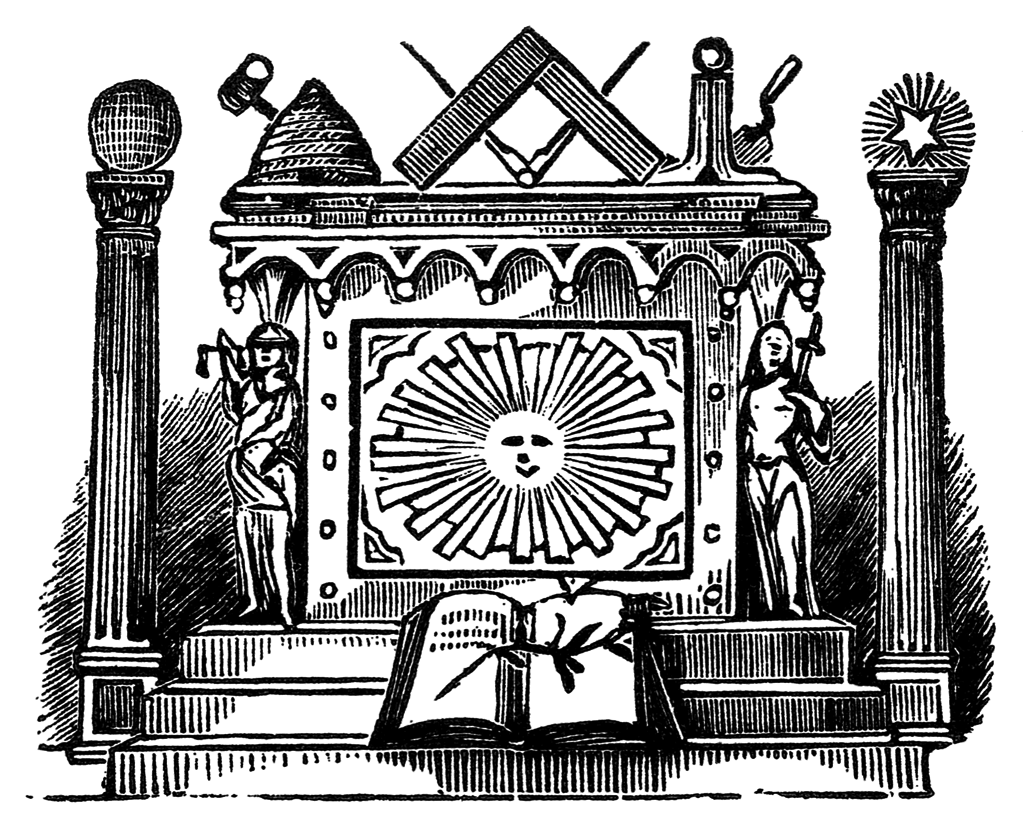
  • Candidates for Freemasonry take their oaths and pronounce their obligations at sacred altars (depicted above) and in the presence of Almighty God, each man using a Volume of the Sacred Law that is sacred to him. (Some men use the Jewish Bible, some a version of the Christian Bible, some the Muslim Quran, and so on.) The obvious conclusion to draw is that the penalties to which Masons bind themselves are penalties that they expect Almighty God shall inflict on them for breaking their word.
The One Possible Time a Murder Might Have Been Committed

In all of history, there is only one instance in which it could credibly be the case that someone who exposed the secrets of Masonry might have been murdered by Masons. This was the famous Morgan incident of 1826, where William Morgan—a non-Mason who pretended to be a Mason, gained admission to lodges, and then published Masonic ritual—is alleged to have been murdered in upstate New York by Masons. This incident has a complicated history, the essentials of which are available here, courtesy of the Grand Lodge of British Columbia and Yukon.

The occurrence of actual murder in the case of William Morgan is questionable. Morgan’s body was never recovered. Some have said that Morgan was paid to go into exile in Canada; some say that they sighted him, towards the end of his life, in the Caribbean. There are those, such as Stephen Dafoe in his recent book, Morgan: The Scandal That Shook Freemasonry, who maintain that Morgan was indeed murdered by Masons; for me, the jury on that case is still out.

If William Morgan was indeed murdered by Masons, this is a horrible thing that should never have occurred, and those who were responsible should have been punished to the fullest extent of the law. However, even if this murder had occurred, its very rarity proves that Masons do not make it a practice to murder, execute, or assassinate those who expose their rituals.

Conclusion

It is time to put to bed the “sensational story” that Ms. Dowd mentions, that “if you expose the secrets of the Masons, they will slit your throat.” This has never been true, as the most basic research by Ms. Dowd would have revealed to her. This is not just a sensational story, but an irresponsible one, even a libelous and prejudicial one, and she should have known better than to spread it around in her book review.

Basic questions about Freemasonry can be addressed to the author through the Freemasonry 101 blog.

Shameless Plugs

I discuss the basics of Freemasonry in my book, Freemasonry: An Introduction, which will shortly be available again through Amazon; interested readers may ask to be notified of this availability through leaving me an e-mail at freemasonrybook@yahoo.com . I shall have a great deal to say about Freemasonry as it is depicted by The Lost Symbol in two places:
  • one of my two chapters in the forthcoming book edited by Dan Burstein and Arne de Keijzer, Secrets of The Lost Symbol, which you can read about here;
  • my own forthcoming book, Discovering The Lost Symbol: Magic, Masonry, Noetic Science, and the Idea that We Can Become Gods. (Publishers’ and agents’ inquiries are welcome!)

[The image is a stylized depiction of a Masonic altar. It is available on the website of the Grand Lodge of British Columbia and Yukon.]

(Copyright 2009 Mark E. Koltko-Rivera. All Rights Reserved.)

Introducing a Series: Maureen Dowd's Review of The Lost Symbol and the Truth About Freemasonry

On Sunday, October 11, 2009, The New York Times Book Review will publish a review by Maureen Dowd of Dan Brown’s latest novel, The Lost Symbol. That review is available on-line here. (The weekday edition of the Times previously published a review of The Lost Symbol by Janet Maslin; that review, which appeared on Monday, September 14, is available here.)

Ms. Dowd’s review contains much inaccurate or misleading information about Freemasonry. I am writing a series of blog posts to address the inaccuracies about Freemasonry that occur in Ms. Dowd’s review. The posts in this series are listed below. (The list will be updated as new posts become available.)

Posts in This Series

  1. Masonic Oaths: Will Masons really "slit the throats of people who reveal Masonic secrets"? (October 5, 2009): post available here.
  2. Are Freemasons Anti-Catholic? (October 8, 2009): post available here.
  3. How Accurate is the Contemporary Catholic Perception of Freemasonry? (October 8, 2009): post available here.

Shameless Plugs

I discuss the basics of Freemasonry in my book, Freemasonry: An Introduction, which will shortly be available again through Amazon; interested readers may ask to be notified of this availability through leaving me an e-mail at freemasonrybook@yahoo.com . I shall have a great deal to say about Freemasonry as it is depicted by The Lost Symbol in two places:
  • one of my two chapters in the forthcoming book edited by Dan Burstein and Arne de Keijzer, Secrets of The Lost Symbol, which you can read about here;
  • my own forthcoming book, Discovering The Lost Symbol: Magic, Masonry, Noetic Science, and the Idea that We Can Become Gods. (Publishers’ and agents’ inquiries are welcome!)

[The image is a rare depiction of the Compasses with a Sector (a traditional symbol of a Past Master) with the All-Seeing Eye on a Disk. It was obtained on the website of the Grand Lodge of British Columbia and Yukon.]

(Copyright 2009 Mark E. Koltko-Rivera. All Rights Reserved.)

Saturday, September 19, 2009

Pyramids, Freemasonry, and
The Lost Symbol


[Photo by Nina Aldin Thune.]

In The Lost Symbol, Dan Brown repeatedly brings up pyramid symbolism in connection with Freemasonry. This would seem to be a mistake, because the pyramid is not a Masonic symbol -- right?

Well -- it's not quite so clear cut.

Oh, I can hear the groans from here. Yes, I know: the various authors in our day who connect Freemasonry with pyramids are considered more than a little out on the fringe, especially by the more responsible Masonic historians of the so-called realistic school of Masonic history. It certainly is the case that, in the year 2009, Masonic ritual, symbolism, and mythic stories all have nothing to do with pyramids.

However, what is true of the early 21st century was not true of earlier days of Masonry, centuries ago.

The fact of the matter is that, at least as early as the 14th century, Masonic literature explicitly connected the Fraternity with Egypt, and (no later than the 18th century) even with the pyramids themselves. Controversial offshoots of Freemasonry in the 19th century associated Masonry with Egyptian initiatory practices.

Finally, the literature of the wilder regions of the conspiracy theory community connects Freemasonry with a very famous pyramid, a reproduction of which exists in virtually every home in America, and this connection should also be addressed when discussing pyramids and Freemasonry.

So, let's have at it.

Freemasonry and Egypt in
the Regius Manuscript


The Grand Lodge style of Freemasonry was established in London in 1717, with the founding of the premier Grand Lodge of England. However, Freemasonry existed before that time, in individual lodges scattered across Scotland, England, and Ireland, at the least -- perhaps for centuries. One of the earliest Masonic manuscripts in existence, the Regius (or Halliwell) Manuscript, dates from about 1390, and specifically draws a connection between Masonry and Egypt when describing the mythic history of Masonry -- in verse, no less. Beginning at line 55, the manuscript states:

The Clerk [i.e., cleric] Euclid in this wise founded
This Craft of geometry in Egyptian land,
In Egypt he taught it full wide,
In diverse lands on every side.

(This excerpt is taken from p. 293 of Coil's Masonic Encyclopedia, rev. ed., 1995. The entire poem is available in a modern translation in Christopher Hodapp's excellent book, Freemasons for Dummies, Appendix A.)

So, Masons of over 600 years ago thought that the Greek mathematician Euclid was an ancient member of their fraternity, and taught geometry in Egypt. Being a Mason, of course, Euclid would have been busy building things. I don't think these would have been shopping malls or amusement parks, either. Thus, at least by implication, the Regius Manuscript leaves open the possibility of Freemasons being involved with pyramids.

Freemasonry and Pyramids in
Anderson's Constitutions


The Grand Lodge era of Freemasonry begins in 1717. The most authoritative document we have of that era is James Anderson's The Constitutions of the Free-Masons (original London edition 1723, republished in the United States by Benjamin Franklin himself in 1734). Anderson's Constitutions include a traditional history of Freemasonry, stretching back to Adam, the first man, as described in the Bible. In this traditional history, Anderson mentions the following, referring to biblical events after the Flood of Noah and the confusion of languages at the Tower of Babel (Ben Franklin's edition, pages 10-11, modernizing the text a bit, omitting a footnote):

And, no doubt, the Royal Art [i.e., Freemasonry] was brought down to Egypt by Mitzraim, the second son of Ham [i.e., Ham being Noah's second son], about six years after the Confusion at Babel, and after the Flood 160 years, when he led thither his colony (for "Egypt" is Mitzraim in Hebrew); because we find the River Nile's overflowing of its banks soon caused an improvement in geometry, which consequently brought Masonry to be much in demand. For the ancient noble cities, with the other magnificent edifices of that country, and particularly the famous pyramids, demonstrate the early taste and genius of that ancient kingdom. Nay, one of those ancient Egyptian pyramids is reckoned the first of the Seven Wonders of the World, the account of which, by historians and travellers, is almost incredible.

Anderson, of course, was drawing on other source material concerning the mythic background of Freemasonry -- the legendary and hypothetical "Anderson Manuscript" -- of unknown age, and that is now lost to us. All we can tell for sure is that at least as far back as nearly 300 years ago, and possibly much earlier, Freemasons mentioned Freemasonry and the ancient Egyptian pyramids in the same breath.

(Incidentally, what did Anderson mean when he said that "we find the River Nile's overflowing of its banks soon caused an improvement in geometry"? The annual flood of the Nile washed away landmarks, and the land on both sides of the banks, for many miles, had to be resurveyed -- through the use of geometry, of course.)

Freemasonry and Egypt in
the Forbidden Rite of Memphis


The basic form of Freemasonry is a system of three degrees, or rituals of initiation. However, over the last three centuries or so, several systems of 'high degrees' have emerged, which offer additional sequences of degrees. In Masonic parlance, a system of degrees is called a Rite (as opposed to the common meaning of a "rite" as a specific ceremony). There are several such Rites in existence today.

In the United States, the main such systems are the Scottish Rite (which offers a system of numbered degrees up to the 33rd) and the York Rite (which offers about 10 degrees in a specific but unnumbered sequence). The York and Scottish Rites and a few other invitational organizations are each accepted by the Grand Lodge authorities in almost all of the 52 sovereign Masonic jurisdictions in the United States (comprising one Grand Lodge in each of the 50 states, the District of Columbia, and Puerto Rico).

But there are other Rites in Masonry -- literally forbidden Rites.

(Cue the creepy trumpet or organ music: DAA-DA-Da-dahhhhhhhhh.)

Over the last three centuries, many different systems of degrees have been put forth to Freemasons, some for the sake of propounding some esoteric knowledge, some for the sake of gathering initiation fees from gullible Masons. At present, in the United States, many Rites have been banned by the various Grand Lodges, although several such Rites have continued to exist on the fringes of Freemasonry for centuries. One such is the Rite of Memphis, originally established in Paris in 1814, a system of up to 100 degrees that has undergone many changes of name and administration and many incarnations over the last two centuries. Although condemned by American Grand Lodges, the Rite of Memphis is active in several parts of the United States today. (No, I am not a member.)

Even the name, "Rite of Memphis," shows some affinity for Egypt. Beyond that, the literature of the Rite of Memphis explicitly connects Freemasonry to Egypt and its wisdom. For example, in a lecture for one incarnation of the Rite, known as the "Antient and Primitive Rite," we find the following in the instruction for members between the 27th and 30th degrees, as published in London in 1882:

Q. What relation does Masonry hold to Egypt?

A. Masonry, considered as a secret society with peculiar ceremonies, having for its aim the conservation of knowledge, truth, and their laws, was received and perpetuated in Egypt by the Sages, who concealed attainments from the vulgar by clothing them in ingenious emblems; from the banks of the Nile the system was carried to the Greeks, Romans, and other ancient nations, where it more or less lost its character and primitive [i.e., original] aim. All the old operative constitutions of the Freemasons trace their origin to Egypt .... The wisdom of Egypt became the proverb of all nations. (Collectanea, 2000, vol. 17, part 2, pp. 85-86; published by the Grand College of Rites of the United States of America.)

A different group derived from the Rite of Memphis, Calvin C. Burt's Egyptian Masonic Rite of Memphis, similarly celebrated the connection between ancient Freemasonry and Egyptian wisdom. This is shown in a handbook published in Chicago in 1867, a portion of which focused in detail on supposed ceremonies of initiation in ancient Egypt, which the author considered Masonic in origin; the author then claimed that his own Rite was founded in France in 1694. (See pp. ix-xiii in Collectanea, 2001, vol. 17, part 3.)

The point here is that traditions on the outskirts or fringes of Freemasonry have connected Masonic initiation with the wisdom of Egypt.

Freemasonry and
the Pyramid
in Your Pocket


Things are so much simpler for the wild-eyed, undisciplined sector of the conspiracy theory community.* There is no need to consult ancient manuscripts, or the handbooks of off-ramp, qwinky forms of Freemasonry: one just needs to look at the paper money in one's wallet or purse, and that settles the matter. In the Anything Goes region of the conspiracy theory community, it is an article of faith that the pyramid shown on the back of the $1 bill, one side of the Grand Seal of the United States, is a Masonic symbol.

The fact of the matter is that this is simply untrue; I state the facts in my comments regarding Clue #35. However, the fact that the conspiracy community believes that the pyramid is a Masonic symbol may simply be enough for Dan Brown.

Conclusion

It is not entirely off-base for Dan Brown to connect Freemasonry with pyramids. In the 21st century, Masonry is not connected with pyramids. However, most of the association between Masonry and pyramids that is portrayed in The Lost Symbol is associated with events supposedly occuring during the days of the American Founding Fathers, roughly the 1770s to the 1790s or so. This was an era only about 60 years separated from the days of Anderson's Constitutions, the original publication of which was still (barely) in living memory. In that era, a connection between Freemasonry and pyramids seemed a bit more plausible.

Of course, it is entirely possible that Dan Brown is merely following the lead of the wilder regions of the conspiracy theory community, in attributing a connection between Freemasonry and pyramids.

I shall have more to say about Freemasonry and its symbolism, as well as the whole issue of pyramids, in my forthcoming book, Discovering The Lost Symbol: The Mind of Dan Brown, the Truth About the Freemasons, and the Idea that We Can Become Gods. (Agents' and publishers' inquiries are welcome. Please contact me through the e-mail portal on my Web Page: see my Blogger profile.)

I remind you that comments are welcome. Feel free to become a Follower of this blog, to forward posts by e-mail, and to subscribe to the RSS feed.

My thanks to an Anonymous commentor on an earlier post, who raised this question.

[The image of the Great Pyramid is Copyright 2005 Nina Aldin Thune. The image was obtained from the Wikimedia Commons through Wikipedia, and appears under the terms of the GNU Free Documentation License.]

*I recognize that there are rational, responsible, careful conspiracy theory researchers. I admire them greatly. However, I find it necessary to take their wild-eyed relatives to task at every turn.

(Copyright 2009 Mark E. Koltko-Rivera. All Rights Reserved.)

Friday, September 18, 2009

"Dressed As a Master":
Clothing in the First Three Degrees of Freemasonry

The Prologue to Dan Brown's The Lost Symbol takes place during a ceremony, the ritual of the 33rd degree of initiation into the Scottish Rite of Freemasonry. We'll go into those matters -- the Scottish Rite, the 33rd degree -- in future posts. What I'll focus on in this post is the fact that the Prologue mentions that the unnamed central character in this Prologue has been through other, earlier initiations -- initiations with distinctive clothing.

As the story mentions:

As was tradition, he had begun this journey adorned in the ritualistic garb of a medieval heretic being led to the gallows .... Tonight, however, like the brethren bearing witness, he was dressed as a master. (Page 3 of the English language edition of The Lost Symbol)

What is he talking about?

The First Three Degrees of Freemasonry

Freemasonry, of course, is a fraternal organization that offers men the opportunity to receive ritual initiations focused on the higher values of life. (My post giving a brief introduction to Freemasonry is here.)

The basic unit of Freemasonry is the Lodge. This is a group of men who meet at regular intervals for Masonic business and ritual. (For example, the Lodge where I became a Mason, Winter Park Lodge #239 Free and Accepted Masons, in Winter Park, Florida, meets on the second and fourth Tuesdays of each month, at 7:30 p.m.) This level of Freemasonry is sometimes referred to (for mysterious traditional reasons) as the "Blue Lodge." It is the foundation of all forms of Freemasonry.

The Blue Lodge offers the first three degrees of Freemasonry:

  • The 1st degree, called "Entered Apprentice"

  • The 2nd degree, called "Fellow Craft"

  • The 3rd degree, called "Master Mason"

Some aspects of the initiation process are similar -- not identical -- across the degree rituals, including clothing.

The Candidate's Clothing

We'll have more to say about Masonic initiation in future posts. Today, it's all about the clothing.

The candidate for Masonic initiation appears in ceremonial clothing for the first three degrees. This is what Dan Brown alludes to as "the ritualistic garb of a medieval heretic being led to the gallows."

Brown is taking a page here from the fascinating book by the late John J. Robinson, Born in Blood: The Lost Secrets of Freemasonry (now available in a new paperback edition from M. Evans). Robinson analyzed certain distinctive aspects in Masonic ritual language and practice, and came to the conclusion that Freemasonry had its origins in a society of men on the run: the medieval Knights Templar, who were condemned by the Papacy and subjected to mass arrests as heretics in 1307. The distinctive garb of the candidate in the first three degrees of Masonic initiation, in Robinson's view, would be a tradition to remember the Templars in their time of trial.

Robinson's conclusions are thought-provoking, although currently they are accepted neither by the mass of Masonic historians nor by most academic historians. Not that this would stop Dan Brown.

"Dressed like a master"

When Dan Brown writes that Mal'akh is "dressed like a master" during his ceremonial initiation into the 33rd degree, he means that Mal'akh was dressed the way a Master Mason dresses following his initiation. Masons typically come to lodge meetings formally dressed. Business suits are common; I know of Lodges that require black tie (that is, tuxedos). (Some Lodges are substantially less formal, but formality is a rising trend.)

Of course, a special apron is the badge of a Mason. The Masonic apron is a tradition that carries today's Masons back to the days of the medieval stonemasons. Today's Masonic aprons are done up rather more elaborately than a medieval stonemason's apron, though.

In the photo above, I am the fellow on the left. (Click on the photo for a larger image.) The occasion is my installation, in late December 2007, as the Marshal of the Lodge in Winter Park; for most lodges, like Winter Park, the annual installation of officers is a public event. (The Marshal is the most junior of Lodge officers.) I am here dressed in a tux, with the specific apron of my office. (Winter Park does not require black tie at its functions, but this was the formal installation, and all officers to be installed arrived in black tie.)

The regular member attending the Lodge would have a less elaborate apron. However, in most essentials, in the photo above I am "dressed like a master," in Dan Brown's phrase.

However, the novel purports to depict, not a Blue Lodge ceremony, but a Scottish Rite ceremony. Thus, I would expect that Mal'akh would be wearing a Scottish Rite cap and "jewel" (that is, a medal), probably the distinctive red cap and jewel of the Knight Commander of the Court of Honor.

So, that is what you should be envisioning Mal'akh wearing in the Prologue: black tie, with a red hat and ceremonial medal. (Head-to-toe tattoos under coverup makeup is entirely optional.)

[The photo above was taken by Ricardo Parente, the webmaster and photographer of Winter Park Lodge #239 F&AM. Thank you, Brother Ricardo, for making me look respectable.]

Thursday, September 17, 2009

Mal'akh's Tattoos, Part 2:
The Scottish Rite Double Eagle

In an earlier post, I described the tattoos on the legs of Dan Brown's horrifying villain in The Lost Symbol, Mal'akh. Today, we talk about the 'main event,' as it were: the tattoos on Mal'akh's chest:

[...] his powerful chest was emblazoned with the double-headed phoenix . . . each head in profile with its visible eye formed by one of Mal'akh's nipples. [The Lost Symbol, Chapter 2, pp. 11-12 in the English language edition]


This sounds to me like one of the most famous symbols of what is called "high degree" Masonry: the double-headed eagle on the seal of the Ancient and Accepted Scottish Rite of Freemasonry (one version of which is illustrated above).

In an earlier post, I describe the degree structure of Freemasonry, and I explain how the Scottish Rite figures into that. Here, I'll just mention that the Scottish Rite offers a set of ritual initiatory ceremonies ("degrees" of initiation) to men who are already Master Masons, that is, men who have received the three foundational degrees of Freemasonry. (More about that in a future post--probably my next one.)

Internationally famous Masonic scholar, Arturo de Hoyos, describes the double-headed eagle in his excellent reference, The Scottish Rite Ritual Monitor and Guide [2nd edition, 2009, available here]. (Incidentally, Scottish Rite brethren, this is the main text of the "Scottish Rite Master Craftsman" course of study.)

The double-headed eagle is the unique symbol of the Scottish Rite .... The motto of the Thirty-third Degree is Deus meumque jus (God and my right). [de Hoyos, 2009, p. 27]
As de Hoyos explains, the double-headed eagle was a symbol in the later degrees of now-extinct degree systems that were predecessors of the Scottish Rite (which was founded in 1801). The double-headed eagle appears on coats of arms, and so is an element or "device" of heraldry.

As a heraldic device its precise origin is unknown, but it is believed to be a modification of the [single-headed] Roman eagle, [a two-headed modification of] which was later used to suggest the Eastern and Western parts of the Roman Empire. This device was subsequently adopted by the German, Austrian, and Russian Empires. Some writers assert an even greater antiquity, equating it with the Storm Bird of Lagash, an ancient Babylonian symbol. [de Hoyos, 2009, p. 28]

So, there is a political meaning to the double-headed eagle: it represents the union of East and West. However, there is also an esoteric meaning, associated with the transformation of inner opposing tendencies into a unified balance or equilibrium within the individual. This is an aspect of alchemy, and the double-headed eagle is a potent alchemical symbol, which explains part of its appeal for Mal'akh.

The black double-headed eagle was a principal motif in early alchemical literature .... At times it is equated with the philosopher's stone, the goal of the alchemical transformation, and may be understood as a symbol of the Great Work of perfection. [de Hoyos, 2009, p. 29]

Of course, this opens up the entire matter of alchemy and the Great Work. Alchemy is one of the wisdom traditions that are incorporated into the degrees of the Scottish Rite in the Southern Jurisdiction of the USA (the organization that has its headquarters at the House of the Temple in Washington, DC--the site of the Prologue of The Lost Symbol).

Alchemy is a vast subject. At a high level, alchemy has to do with the management and direction of transformation -- a subject that is near and dear to the heart of Mal'akh, as readers of The Lost Symbol observe throughout the novel. There is an aspect of alchemy that is concerned with transformation of outer reality. (This is where the whole turning-lead-into-gold thing comes up.)

There is also an aspect of alchemy that is concerned with transformation of inner reality. The point of alchemy is to bring the opposing tendencies of human nature into balance and under the control of the individual. Through alchemical processes, the individual is to refine human nature, thereby bringing the individual to a new level of human consciousness, and a more perfect state of being.

Mal'akh's tattoo is described as a double-headed phoenix, a mythical bird also associated with inner rebirth. Again, transformation is Mal'akh's thing.

I shall have more to say about alchemy, as well as its relation to Masonic symbolism, in my forthcoming book, Discovering The Lost Symbol: The Mind of Dan Brown, the Truth About the Freemasons, and the Idea that We Can Become Gods. (Agents and publishers inquiries are welcome; I may be reached by e-mail through my Blogger profile.)

Learning More About Alchemy

A fine brief introduction to alchemy is the chapter by Richard Smoley, "Hermes and Alchemy: The Winged God and the Golden Word," pp. 19-30 in an excellent collection of essays edited by Jay Kinney, The Inner West: An Introduction to the Hidden Wisdom of the West (New York: Tarcher/Penguin, 2004). The notes to this chapter constitute good suggestions for further study.

The interest of Sir Isaac Newton in alchemy is little-known to the public at large, but Newton wrote more about esoteric subjects like alchemy than he ever wrote about physics or optics. One can read about this in Michael White's biography of Newton, Isaac Newton: The Last Sorcerer (New York: Basic Books, 1997).

Alchemy from the point of view of a modern practitioner is described by Mark Stavish in The Path of Alchemy: Energetic Healing and the World of Natural Magic (Woodbury, MN: Llewellyn Publications, 2006).

In recent years, there has been a revival of interest in the concept that Masonic ritual somehow is connected to alchemy. The most detailed recent treatment of this idea can be found in Timothy Hogan's The Alchemical Keys to Masonic Ritual (2007), which is available through lulu.com, as shown here.

A Small Point of Masonic Etiquette

I removed a comment from one of the posts on this blog recently, because it ventured into the area of Masonic passwords, signs of recognition, and so forth.

The author of the comment has posted before, and seems to be a fine and upstanding individual, quite bright, even scholarly. The source cited was a fine, scholarly work, not anti-Masonic at all.

However, as a Mason, I have made a commitment not to reveal the Masonic passwords or signs of recognition. As I interpret that obligation, that includes not discussing purported passwords or signs of recognition, past or present, in a forum for which I have personal responsibility, such as this blog.

I realize that non-Masons typically do not know the contents of the Masonic obligations. I bear no ill will to the commentator. However, I do ask everyone who comments on this blog to steer clear of the matter of Masonic passwords and signs of recognition, out of courtesy to your blog author, a Mason. Thank you for your kind observance of this principle.

Wednesday, September 16, 2009

Mal'akh's Tattoos, Part 1: The Pillars, Boaz and Jachin

In Dan Brown's The Lost Symbol, the magnificently creepy villain called Mal'akh is tattooed on almost every inch of his body, except for a spot on the crown of his head. But these are not just any old tattoos. Mal'akh's tattoos incorporate all kinds of esoteric and mystical symbolism -- some of it Masonic in nature. Mal'akh may be a torturer, he may be a criminal sociopath, he may be the human equivalent of a demon -- but he aspires to all sorts of spiritual knowledge, and he reflects his spiritual aspirations in his tattoos.

Two of Mal'akh's tattoos are on his legs. As described in Chapter 2 of The Lost Symbol (page 11 of the English edition):

... his muscular legs were tattooed as carved pillars -- his left leg spiraled and his right leg vertically striated, Boaz and Jachin.


So, what is this about?

For almost three hundred years, it has been public knowledge that two important symbols in Freemasonry are the pillars Boaz and Jachin. Anciently, pillars with these names were part of the Temple built by King Solomon. In the Bible, the construction of the Temple is described in a couple of places, one of which is the First Book of Kings. The 7th chapter, verses 15 through 22, describe the pillars, at the conclusion of which we read:

And he [Hiram, the master builder] set up the pillars in the porch of the temple: and he set up the right pillar, and called the name thereof Jachin: and he set up the left pillar, and called the name thereof Boaz. (1 Kings 7:21)

The name Jachin translates to "God will establish"; Boaz translates to "in strength." Thus, one meaning of the pillars is that they signify that God established the Temple in strength.

There are ancient legends associated with the pillars, some of which have shown up in Masonic symbolism. One legend is that the pillars were topped with globes, one showing the globe of the Earth ("the terrestrial globe") and the other the globe of the heavens as seen from the Earth ("the celestial globe"). You can see these globes atop the pillars in the illustration above (from a 1920's edition of Albert Mackey's History of Freemasonry). Another legend is that there was secret wisdom written on records deposited within the pillars. Yet another legend (shown in Dan Brown's novel) is that one pillar was decorated with carvings horizontally, the other vertically.

What is the significance of the pillars in Masonic symbolism, and why are they of interest to Mal'akh? There is much that could be said about this, only a portion of which I can mention here.

The pillars Boaz and Jachin signify the entrance to the Temple built by Solomon and dedicated to God. Some representation of these pillars is found in most Masonic lodge rooms. Their presence helps to mark the Masonic lodge room as a sort of sacred space, where people take a different perspective on their lives than the everyday point of view. The "journey" of initiation into Freemasonry begins as the initiate symbolically enters the Temple built by Solomon.

The names of the pillars are a reminder to the Mason that, as the outward Temple was established in strength by God, so too the Mason invites God to establish his own life in strength. (Of course, if the Mason invites God to establish his life, he'd better be living the kind of life that God can support.)

As the globes atop the ancient pillars were representations of the heavens and the earth, so too the Mason seeks for knowledge of the natural universe, near and far.

As the ancient pillars were said to be repositories of wisdom, so too the Mason is on a journey in search of wisdom.

These are the values that Mal'akh was dedicating himself to: the search for wisdom. The tragedy of Mal'akh, in part, is that he did not understand that the search for higher wisdom requires kindness and respect for other human beings, in order to be a fully successful search.

I shall have a great deal more to say about Masonic symbolism as it appears in Dan Brown's novel in my forthcoming book, Discovering The Lost Symbol: The Mind of Dan Brown, the Truth About the Freemasons, and the Idea That We Can Become Gods. (Agents' and publishers' inquiries are welcome.)